Showing posts with label Saudi. Show all posts

Saturday, January 20, 2018

Crustaceans in the Arabian Gulf (I): Crabs 阿拉伯灣的甲殼類 (I)螃蟹

The Arabian Gulf is a shallow sea with depth mostly less than 60 m. The seabed is generally covered by soft-materials, such as sand and mud. In the nearshore waters along the coastline, there are belts of sea-grass/macro-algae meadows, which nourish plenty of invertebrates and fishes. According to the archeological study , people living along the coast of the Arabian Gulf have been harvest various marine organisms for thousands of years. 

There is a misunderstanding that the Arabian people do not eat anything from the sea but fish, which is not the case at least in present days. Crustaceans, crabs, sand lobsters, and prawns, are one of the most important invertebrates that are commercially harvested by the fishermen in the Arabian Gulf. Shrimps, either caught from the wide or cultured in the ponds, are popular food items widely consumed by the people living in Saudi Arabia. Lobsters are rare and expensive delicacy often found in the restaurants. On the contrary, the crabs, mostly the blue swimming crab (Portunus pelagicus), are also harvested in large quantities but receive seemingly far less attention from the local people. In Bahrain, crabs are listed in the menu at times, but it is rarely found in the restaurants in eastern Saudi Arabia, suggesting that people do not have good appetite for crabs [Remark: Blue swimming crab is considered as four different species, and the one distributed in the Arabian Gulf is proposed to be Portunus segnis. However, i still keep use the old name Portunus pelagicus for the blue swimming crab.] 

阿拉伯灣是一個深度多在60米以下的淺海地區,海底多是軟質的沙泥混合地質所組成。在靠近海岸的地區,有一連串的海草/海藻床,孵育了大量的無脊椎動物和魚類。根據研究指出,在阿拉伯半島沿海地區的人民,捕撈海洋生物為食,已經有數千年的歷史。通常對於海灣地區的阿拉伯人有個誤解,認為海洋生物他們只吃魚。但至少在現今,他們不只吃魚,也很愛吃蝦子。不管是野生或是養殖蝦,沙烏地人都消費了相當可觀的量。龍蝦,也是常出現在餐廳裡的高級美食。然而相對於前兩類,螃蟹類在這裡的確沒什麼出現。在對岸的巴林,偶爾還會出現在餐廳的菜單上,但是在沙烏地東邊,螃蟹極少出現在餐廳,代表出沙烏地當地對於螃蟹可能還沒有很高的接受度。


遠洋梭子蟹(市仔)是沙烏地阿拉伯灣海域最常見的食用螃蟹種類。
  Blue swimming crab (Portunus pelagicus) is the most common commercial crab species

市仔在巴林偶爾會出現在餐廳,但在東沙烏地相當少見。
 Crabs show up occasionally in the Bahrain restaurants, but is rarely seen in those in eastern Saudi
在沙烏地阿拉伯東岸,螃蟹漁業最主要在南邊的海域
In eastern Saudi Arabia, the crab fishing ground mainly located at the southern part

魚貨上岸時,習慣是將雌雄分開。這是身體偏褐色、大螯較短的雌性。
The fishermen usually separate males from the females. Female crabs are brown-bodied with shorter claws.

雄蟹通常體型較大、步足藍色、大螯也較長
Male crabs are usually larger with longer claws.

這邊海巡檢查蠻盡責的,每一箱螃蟹都要倒在平台上,確定沒有夾帶東西。
All the landings have to be checked before going to the market.

這漁港漁民主要用陷阱抓螃蟹,過期的魚就拿來當誘餌
This fisherman uses crab pot to catch the crabs, and the out-dated fish are the baits


開始烹調,先來個兩隻吧
Let's have two crabs for the dinner

港式避風塘炒蟹
Crab fried with Crispy Garlic (Hong Kong Style)

三杯炒蟹
Fried crab with Thai basil
鏽斑蟳 Charybdis feriatus 俗名花市仔,在沙烏地阿拉伯灣海域極少抓到,可說是夢幻的 種類。
Crucifix crab (Charybdis feriatus) is a crab rarely found in the Saudi waters in the Gulf.
鏽斑蟳味道是和市仔好上一些。
Crucifix crab tastes a bit better than the blue swimming crab.


Seafood is popular in Saudi Arabia, as in other countries. However, unlike in Asia countries where blue swimming crabs have decent prices, the crabs in eastern Saudi Arabia are among the cheapest item in the market with little interests from the local people. Frankly, I do not think the crabs here are as tasty as I have tried in Taiwan and other East Asian countries. Two critical issues are the lacks of proper preservation and food processing techniques. All crabs landed are dead, and therefore they do not fit well with Taiwanese or Chinese style dishes that are better with live crabs. (I do not have the courage, or a strong stomach, to try to make the "green mango salad with raw crab"). Also, there is no (or least little) industries that could peel the crab and sell the meat, either being frozen or in cans. Considering the fact of lack of appetite on crabs from the locals, most of the crabs landed in eastern Saudi Arabia should have gone to other places. This industry could have better profit if the cabs can be kept alive (for the Asia markets), or the meat could be extracted (for the western markets).

沙烏地就像其他國家一樣,海鮮相當的受歡迎。在亞洲國家,市仔要價通常不斐。但是在沙烏地東岸,螃蟹通常是最便宜的選項,當地人民對螃蟹也興趣不大。老實說,這邊的螃蟹肉蠻軟的,比不上和我在其他國家吃到的螃蟹 。這邊的螃蟹漁業,缺乏適當的保存技術,也沒有適當的食物處理技術。上岸的螃蟹都是死蟹,也因此在強調活蟹的台灣或中國料理上,就沒有那麼適合 (我也不敢嘗試,也沒那個胃,去做生螃蟹芒果沙拉)。另外,這邊也沒有引入螃蟹取肉技術。考量這邊人民對螃蟹沒什麼興趣,捕撈上岸的螃蟹,相信是輸出去其他地方。因此如果能夠引入活蟹保存技術,或是取蟹肉工廠,來滿足亞洲或歐美市場,這產業可能會有更高的獲利。

Thursday, December 21, 2017

台灣附近海域海溫圖及與阿拉伯灣西部海域之比較 Sea surface temperatrue around Taiwan and comparison with Western Araban Gulf waters

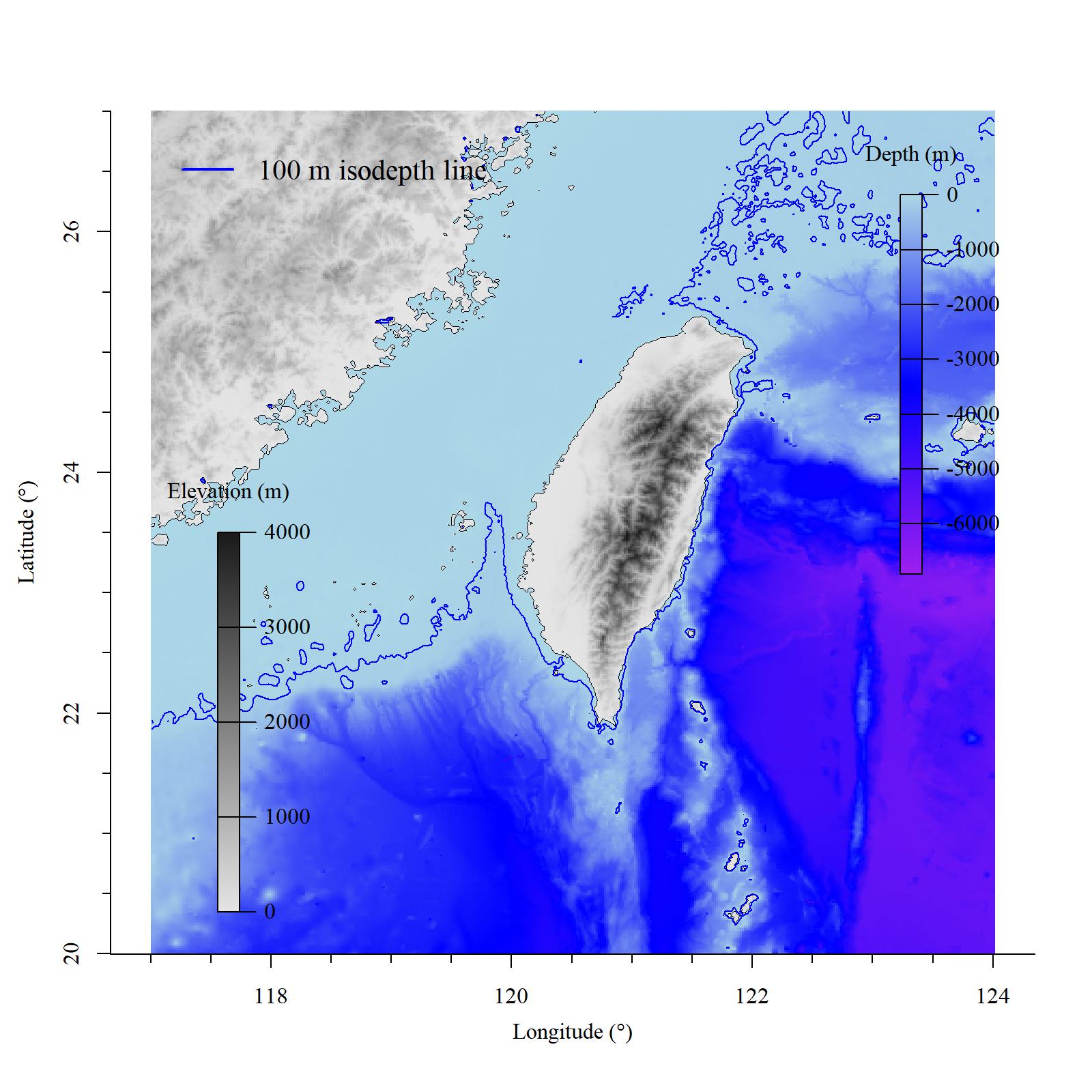
許多水文資料,都可以在網路上得到,再應用開放軟體的套件,就可以做出漂亮的圖。我還沒想到,不到兩個小時,就可以完成台灣附近海域的海底地形圖,也順便做了個海溫分析。首先我去全世界地形資料庫(Smith and Sandwell, 1997),輸入想要的範圍後,就可以輕鬆取得經緯度以及高度的資料(XYZ data)。利用統計軟體R及marmap套件,不到30行的指令,就可以做出下圖:

In recent days, it is easy to obtain detailed information through web-sites. Then by applying the packages in the open-source software, it takes me less than 2 hours to finish these plots and analysis, quite surprising. At first, i visit the website "Extract topography", which provides longitude, latitude, and altitude for selected range. The by using the statistical software R and package "marmap", i make following bathymetric map in less than 30 lines
Bathymetric map for waters around Taiwan 台灣周圍海底地形圖
從上圖而知,台灣海峽相對算淺的,大多都在100m以淺。在澎湖和嘉義間有條較深的海洋低谷,然後在高雄外海就有比較深的大陸波。然而在東部有夠深,出去沒幾下子就超過3000m,一直到宜蘭中部才比較淺。也難怪大溪漁港會有那麼多的深海魚。

We can see that Taiwan Strait is relatively shallow, mostly less than 100 m. At the east of Pong-Hu Islands there is a deeper valley, and waters offshore Kaoshung has also a deeper slope. On the other hand, there is a extreme steep slope at the eastern Taiwan. It can go up to 3000 m in a couple of 10 km offshore. Only until to the northern Taiwan the bottom becomes relative shallower. That is also the reason that the trawlers operating around this water catch a lot of deep-sea fishes.


接下來去很威的美國國家海洋與大氣署的全球每日海表層水溫資料庫 (NOAA OISST database),來擷取上圖台灣附近的每日表層海溫,再去做每月的平均:
Then I obtain the daily sea surface temperature of waters around Taiwan from NOAA OISST database, and calculate the monthly mean value:

2017 February Sea surface temperature 2017年二月台灣海表水溫圖
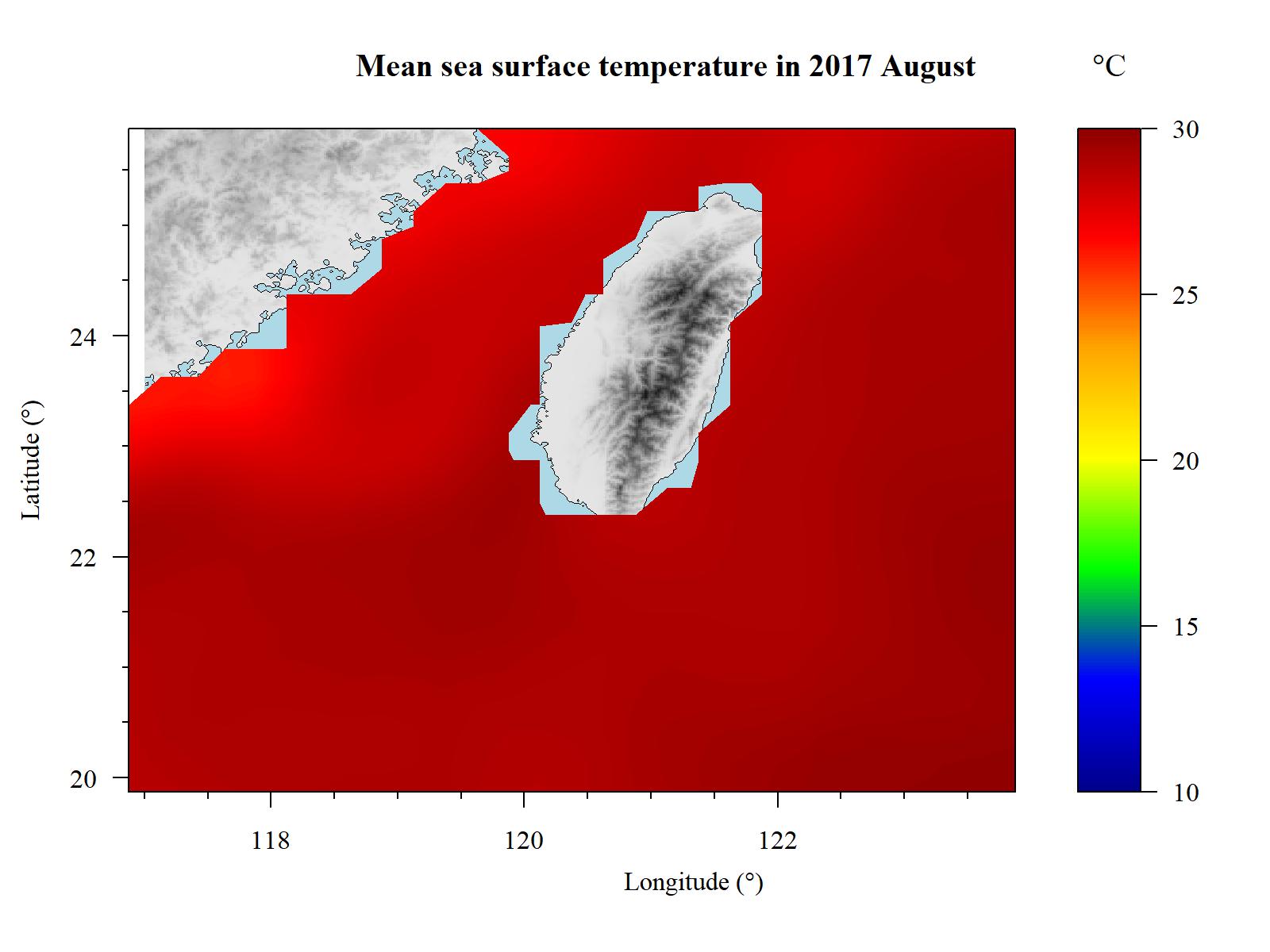
2017 August Sea surface temperature 2017年八月台灣海表水溫圖

基本上,相對於東邊的深處,台灣西北邊有相對劇烈表海溫季節差異。然後,為了好玩,我做了一個動畫,表示台灣附近海域從2010年一月到2017年10月表水溫的變化。

Compared to the deeper eastern Taiwanese waters, the northwestern part of Taiwan exhibits stronger seasonal contrasts. Out of fun, i make a gif animation on the monthly sea surface temperature of  waters around Taiwan from January 2010 to October 2017.


Monthly changes in SST of waters around Taiwan from Jan 2010 to Oct 2017. 2010年一月至2017年十月台灣附近海域每月海表溫的變化圖


最後,計算出1982~2016的每月長期資料,和同時期阿拉伯灣西部,沙烏地海域的表水溫做比較:
Lastly, i calculate the average monthly SST from 1982 to 2016 for waters around Taiwan, and compare those values with the western Arabian Gulf, the Saudi Arabian territorial waters in the Gulf:
The long-term monthly SST of waters around Taiwan (black line) and western Arabian Gulf (red line) from 1982 to 2015. Error bars indicate the standard deviation. 從1982至2015,台灣附近海域(黑線)和阿拉伯灣西部(紅線)的每月平均表水溫變化圖 (誤差線表示標準差)。

台灣附近海域,相對於阿拉伯灣西部,有比較穩定的季節性海水溫。西部阿拉伯灣的環境,比台灣要更極端,最高溫較高,最低溫也較低,同時每月的溫度變化也較台灣高。
Compared to the western Arabian Gulf, the waters around Taiwan have relatively stable in terms of SST. The western Arabian Gulf exhibits more extreme environment, with higher monthly maximum, and lower monthly minimum, as well as higher variation within a month.

這些圖我想應該還粗糙的,但主要想表達原來開放資料和開源軟體這麼強大。以前可能要用很專業的付費軟體分析,但是現在用網路上的可靠資源,就可以在短時間內做出很不錯的結果。Although these plots may be still rough, it is still very incredible that one can use open-source data and freeware, instead of paid professional software, to make such interesting figures!


Friday, August 14, 2015

沙丁魚和鯷魚 Sardines and Anchovies

The Arabian Gulf is a blessed region with plenty fish resources. The fish market is full of wild-caught fish from various habitats, such as coral reef, rock, seaweed meadow and pelagic waters. In Saudi fishermen mostly target large predatory pelagic fish, the Spanish mackerel, and small tuna and other pelagic fish is regarded almost as "bycatch" and sold with cheaper price. There are not yet fisheries for small-pelagic fish, such as sardines and anchovies. However, in the retail market there are usually "large" sardines available and i guess they may come from other regions, such as Oman or India, for their relatively bad freshness. But one day there are really fresh ones in the supermarket, and thus i gave them a try.

For the first try, i did not clear the stomach, just wash them, and pan-fried the sardines with olive oil. These sardines are really oily, the fish oil kept going out during being fried and they left more oil than i added in the beginning. Next time, i should not need to add too much oil as this time.

Thy tasted wonderful.

As a Taiwanese, fried Pacific saury (Cololabis saira) is a common dish on the table. It is nutritious full of healthy fish oil, large quantity, easy to get for the frozen ones, and cost next to nothing to have one. The fried sardines made me remind the saury, which is a key to the childhood memory. They also had much fish oil, with a white-brown meat being bit hard. When adding some lemon juice, they become more delicious for the sourness from the lemon "neutralized" the greasy from the fish oil. They are really good fish (as long as they are fresh).

沙烏地面對阿拉伯灣的地區,是一塊漁業資源富裕的海洋。漁市場有各種棲地的魚,如珊瑚礁、岩岸、海草床、以及中表層魚類。在中表層魚類中,土魠是沙烏地漁民主要捕撈大型捕食性中表層魚類 ,而其他包括小型鮪魚的中表層魚類,幾乎被漁民認為是混獲,價格無法與土魠相提並論。在這裡,還沒有發展針對像是沙丁魚鯷魚等小型中表層魚類的漁業,但在市場上,有時就可以看到體型相對算大的沙丁魚。因為這些沙丁魚相對來說鮮度較差,因此個人猜測,這些在市場上販售的沙丁魚應該都是從其他地方,像是阿曼或是印度運來的。而在有次去市場購物時,那批沙丁魚鮮度真的不錯,所以我就去嘗試一下。


這次沒有把魚內臟去除,將魚洗乾淨瀝乾後,就把魚用橄欖油煎熟。這沙丁魚還蠻油的,在煎的時候魚油不斷跑出來,最後鍋子還留下比我當初加得更多的油,下次只需要加一點點油就好。

魚好吃。

身為一個台灣人,因為秋刀魚價美物廉又營養豐富,所以煎秋刀魚長出現在餐桌上。而這次的煎沙丁魚,味道讓我強烈連想到秋刀魚,一種童年的味道。和秋刀魚一樣,沙丁魚也是充滿魚油,而且魚肉在煎熟後也是棕色又帶有點硬。加點檸檬汁,用酸味來解來自魚油的油膩感。這次的嘗試非常舒服,這邊市場賣的沙丁魚,只要新鮮,真的是好吃。

Pure-seiners in the Basque country for the small pelagic fish 
巴斯克地區捕撈小型中表層魚類的圍網漁船。
Sardines as the main catch from this Basque purse-seiner
巴斯克漁船所捕撈的沙丁魚。

A large sardine (> 20 cm) from local retail market. Broken stomach probably implies bad freshness. 
在當地市場買到的大型沙丁魚(全長超過20公分)。然而肚子上的破洞可能代表鮮度欠佳。

Fresh sardines (possibly different species) from the supermarket 
在超市買到的新鮮沙丁魚,和上圖應該是不同種類。
I simply pan-fried the sardine with olive oil. Delicious. 
簡單用橄欖油煎煎,沙丁魚就是一道美食。

In other occasion I literally caught some sardines from the sea. Although they are smaller, I can be certain that they are REALLY fresh. Then I had this second try. Similar to last time, i pan-fried the sardines with little olive oil, and added some garlic slices for more flavor. Then put on the plate and garnished by lemon slice. This time is great, too. The sardines have hard scutes in the belly, making they less favorable in the market. I can easily remove the scutes, as well as the bones. The meat is white-brown, and has less "red meat" (血合 as called in Japanese) that gives it stronger, bloody, and metallic taste compared to the saury.

Again this time further supported that the fresh sardines are good to have. (It would be better if i could have had it with a glass of dry white...).

第二次嘗試,就是正港現撈的沙丁魚。和上次一樣,用少量的橄欖油去煎,但加點蒜片提味,然後和檸檬片一起裝盤。這次同樣很好。這裡人們不喜歡沙丁魚的原因之一,就是沙丁魚腹有一排硬鱗,造成口感不好,所以需要額外挑除。但我覺得這排硬鱗,和魚中骨一樣很容易剔開。煎熟的魚肉介於白色和棕色之間。和秋刀魚相比,沙丁魚魚肉很少血合肉,因此吃起來不會有帶點血味。

這次嘗試一樣是很好的經驗,這邊的沙丁魚還蠻好吃的,如果能有一杯不甜的冰白葡萄酒就更完美了...


Smaller really fresh sardines
新鮮的現撈小沙丁魚
Pan-fried the sardine with olive oil and garlic. Garnished with lemon slice 
一樣用橄欖油煎,這次加點蒜片,起鍋後和檸檬片一起裝盤。
Easy to separate the meat from the bone. Sardines have less smelly "red meat"
很簡單就可以骨肉分離。沙丁魚的肉比較白,同時味道重的血合肉也比較少


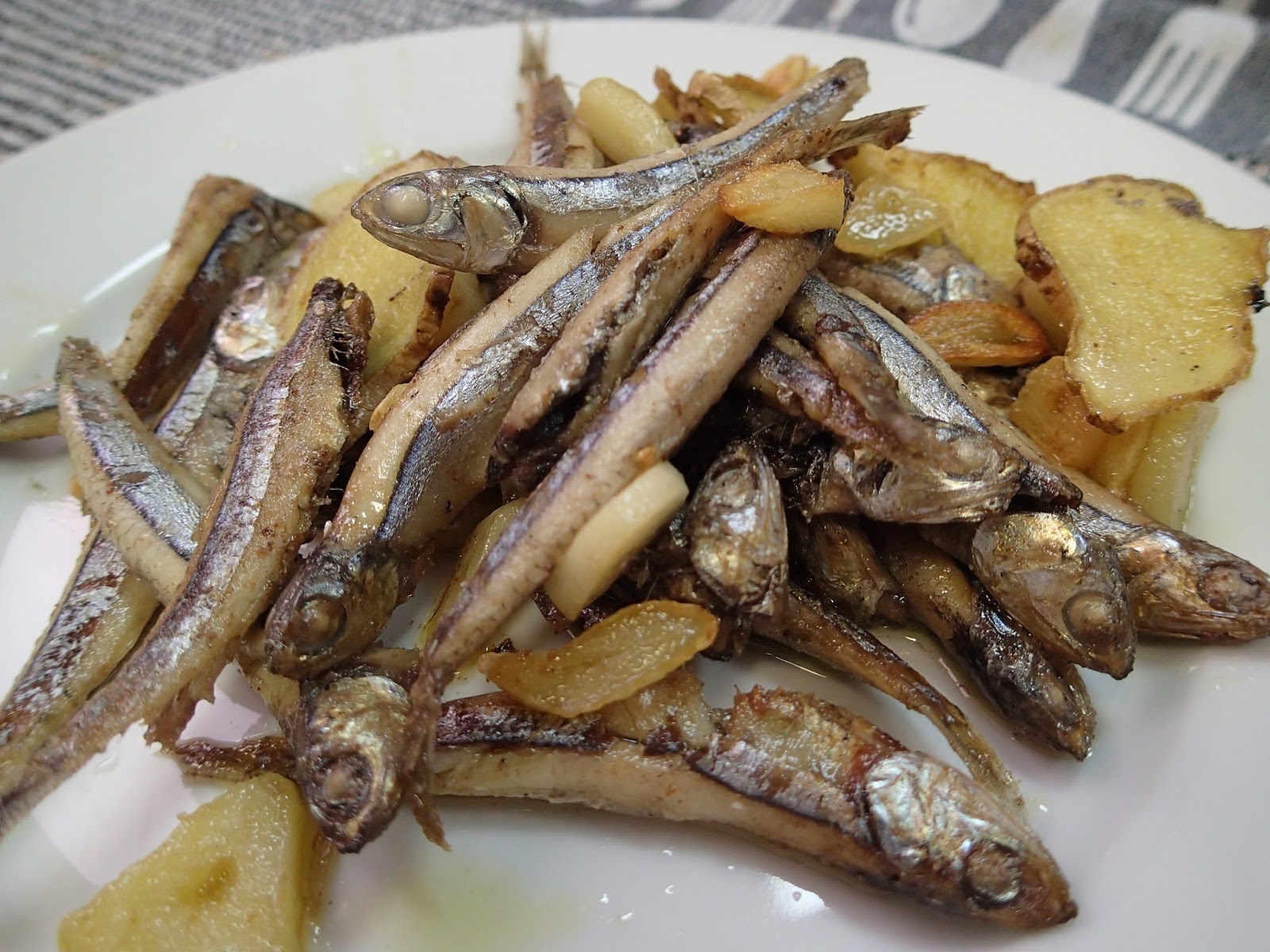
When in the Basque country, I had another impressive experience for the small pelagic fish: fried anchovies with garlic. In fact two things made me remember this dish: it is tasty, and the way my friend had it. They can remove the bone and eat only the meat from such small-sized fish. I could not do that delicate work and was only able to eat them whole. However, the anchovies are not consumed fresh here. Mostly they are sold as dried fish or salted fish, and most likely from India or other countries.

In another occasion i had some really fresh anchovies. So I have a chance to try this dish at home. I added some salt on the anchovies and put them in the fridge for a few hours. Then i put the anchovies in a hot pan with a bit more olive oil. Because they had stronger smell after being defrost, i added a few ginger slices (a common practice in Chinese cuisine to remove the bad flavor from the fish) in addition to the garlic slices.

As in Basque, I eat them whole for I cannot remove the heads and bones from the anchovies. They are good, especially for them have been simmered in salts for a couple of hours. Eating with garlic slices and/or ginger slice gives the fish a different flavor and taste. It is in some degree similar to a common Taiwanese dish, fried anchovy dry (炒丁香) that replacing the dried anchovies with fresh ones. It is a nice one as a snack or side-dish.

當我在巴斯克地區時,朋友有吃一道蒜片炸鯷魚。當時對這道菜除了他的美味之外,還有巴斯克友人可以用刀叉把鯷魚骨頭分開來吃的神技。可惜我刀叉沒有用的那麼熟練,只能連著骨頭一起吞下去。在沙的市場並沒有新鮮鯷魚,大多是從印度進口的鯷魚魚乾,就像是台灣的小魚乾一樣。在偶然的機會下,有機會拿到一批新鮮的鯷魚,就來試試看這到在巴斯克吃到的菜。

首先先將解凍好的鯷魚灑點鹽巴,放到冷藏庫醃個幾個小時。將稍微多點的橄欖油放入熱好的平底鍋,將醃好的鯷魚放下去,和蒜片薑片一起半煎半炸,大約不到五分鐘鯷魚表面變得酥脆就可以起鍋了。如果想要硬一點,也可以再炸久點。

就像在巴斯克一樣,我還是懶得去頭去骨頭,就給他這樣直接吃下去。味道很不錯,橄欖油替炸過的魚肉加點特殊的風味。配合炸酥的蒜片和薑片一起吃,又讓味道有些變化,吃起來就像是我們的炒丁香魚,只不過魚不是魚乾,而是新鮮的魚。雖然不知道下一次是什麼時候,但是這次是個很不錯的體驗,當作是配菜或是點心都很不錯。


Another impressive dish in the Basque: fried anchovies with garlic 
另外一道印象深刻的菜:炸蒜頭鯷魚

Fresh anchovies 
這次要嘗試的鯷魚


Frying anchovies in olive oil with garlic and ginger slices 
用較多的橄欖油,和蒜片薑片一起煎鯷魚

Done. I left most oil in the pan.
煎好的鯷魚。

Previous try. It was fried a bit longer but is still tasty. 
同場加映: 之前的一次嘗試,炸的有點久但是一樣好吃。


Tuesday, August 11, 2015

Crustaceans (II): Lobsrers 甲殼類 (II): 海戰車和龍蝦

In this blog, I am going to introduce the "star" of the crustaceans, the lobster. It is interesting to state here that in Arabic here, the lobster is called "Um al Rubiyan", meaning the mother of the prawn. The coast of the western Arabian Gulf is mostly sandy and muddy, and therefore, it is rare to catch "rock lobster" in the wild. Presently some concrete breakwaters have been deployed to create "corniche" place for local residents. The crevices between breakwaters might be suitable habitats for the rock lobsters, as they did in Taiwan, but so far I have never seen or heard that rock lobsters are caught there. Although the rock lobsters are available in some local retail markets, they are (as per the fish salesperson) imported from rocky area, such as Oman, or the Red Sea.

在這一篇文章,來介紹甲殼類的明星: 龍蝦。有趣的是,在這邊阿拉伯文龍蝦稱為"Um al Rubiyan",蝦子的媽媽,也顯示阿拉伯人的幽默。通常龍蝦喜歡棲息在礁岩的縫隙中,但阿拉伯灣西側基本上都是沙泥灘,所以幾乎都不會看到龍蝦出現。近幾年沙烏地政府改造沙灘,在海邊放置許多人造石頭並建成海岸公園供居民遊憩。因此這些人造礁岩的縫隙,可能增加一些龍蝦類的潛在棲地,就如同台灣有釣客會在消波塊的縫隙中找到龍蝦。但是至少目前為止,我都沒有在這邊聽到在人造礁岩中發現龍蝦的案例,可能還少了什麼因素吧。雖然在當地魚市場偶爾可看到長鬚的龍蝦,但是幾乎都可以確定是來自國外的進口貨,可能是南邊的歐曼,也可能是來自於紅海那側吧。


Rock lobster from local retail market, possibly imported from Oman.
這邊市場上買得到的"真"龍蝦,應該是從阿曼進口的舶來品。


The most common lobster in the Western Arbaian Gulf, Sand lobster Thenus orientalis
阿拉伯灣西岸最常見的龍蝦,沙龍蝦(海戰車, Thenus orientalis)
Take two sand lobsters for a try
拿兩隻來嘗試看看
Simply wrapped in the alum foil and roasted in the oven. They are more being steamed.
用鋁箔紙包好後直接放進烤箱烤。因為包起來烤,所以反而比較像是用蒸的。
More lobsters. This time add they are roasted with some salt.
更多的龍蝦。這次加點鹽烤。

It seemed that they were in the oven for too long. The meat was better but also drier. It is OK, just like a bigger bite of a prawn.
加鹽烤有比較好。可惜好像烤太久了,肉有點乾。吃起來...就像是比較大塊的蝦肉,是不錯啦,但如果便宜一點就更好了。


Trying another way. I made the stock from the head and the carapace.
換另外一種做法,先將蝦頭和殼用水煮出蝦高湯。

They I made a lobster pasta with the stock. A more luxury version, but without one key ingredient...
取出來的蝦肉,就和蝦湯一起做成鮮蝦義大利麵。可惜就是少了一味..

Another try. This time I cut them in half.
更多的龍蝦。這次對切
Adding some flour on the meat side, and frying them in the pan. This time was better.
在肉的切面撒上麵粉,在平底鍋用油煎熟。這次就不錯,看起來就很奢華。


More lobsters. 
更多的龍蝦。

A feast on lobsters. 
龍蝦大餐
A bigger one in dinner. 
某天的晚餐,一隻大龍蝦


Another lobster species, very rare... 
另外一種龍蝦種類,在珊瑚礁棲息,在魚市場非常罕見!

The gonad of this lobster, quite large in quantity. 
那隻龍蝦的生殖腺,還蠻大量的

The meat was taken, along with the gonad. 
蝦肉生殖腺取出冷凍保存。

I decided to make them a shrimp pasta. I fried chopped garlic with the olive oil, and then put the lobster roll in. 
後來決定做龍蝦義大利麵,將蝦肉和切碎的大蒜和橄欖油一起煎炒。

Done! I should have not added the gonad.... 
做好了! 味道嘛...我不該加生殖腺進去的...
In conclusion, the sand lobsters are an interesting species to try, if the budget is not too tight. It don't appear all year round in the fish retail shops, mostly during the trawling season and caught by a special technique. In some fishing market, at times they are very fresh that the sand lobsters are moving. I think they need better culinary skill to make them out-standing, especially considering their high prices. I will not recommend to have rock lobster here, because they are imported somewhere and usually with lower quality.

沙龍蝦,算是種有趣的物種,有錢有閒可以嘗試一次。在特定的季節,通常是下半年的拖網季節,才會在沙烏地東岸的魚市場偶爾出現。有時候,鮮度相當好,龍蝦甚至還會動。然而,個人廚藝技術太差,目前覺得龍蝦沒有特別好吃,特別考量到它尊貴的價格...我更不會推薦在沙烏地東岸吃岩龍蝦,畢竟都是進口,經過冷凍解凍幾次後,狀況只能說慘不忍睹。要吃那種龍蝦,不如在產地吃新鮮的,比較對得起荷包。


Saturday, December 20, 2014

沙烏地蛤蜊的愛恨情仇 My complex about Saudi Clams


"一次又一次選擇相信,但一次又一次被背叛"...這大概就是我對於沙烏地蛤蜊的寫照吧...

雖然因為在漁業組工作的關係,常常可以有新鮮的魚可以吃。然而對於一個台灣人,生活長可以圍繞在不同種類的蛤蠣、海瓜子等,不能享受到貝類,總覺得好像少點什麼東西。可能是因為沙烏地人不大吃蛤蠣,而主要是外國工作人士才吃雙殼貝類,所以這邊主要都是當地的傳統市場零星在賣,頂多超市的海鮮區偶爾會出現。也因為看到的時候,這些蛤蠣都是雙殼打開的死貝,所以只能先按耐自己想吃的心,耐心等待時機啦。

還好,沒有多久,我就在超市看到一批還算新鮮的貝類。因為還是有大概五成的死貝,所以也沒買多,先買個一公斤試試看。雖然有一半是死的,但是煮起來的味道很好,和台灣的蛤蠣不大一樣,但是吃起來的經驗很不錯。總算,我可以在沙烏地也吃到蛤蠣了,當下心情大好。第二次更是買到珍貴的海瓜子,吃起來也是相當的舒服阿...只希望在買多一些...第三次嘗試蛤蠣薑絲清湯,在寒冬的晚上,來完個蛤蜊湯真是相當的舒服阿

Although I usually have fresh fish from the sea because of working on the fisheries, I still have few chances to taste the clams in Saudi. Most likely the Saudis do not consume the clams, at least only in artisanal scale and probably the expats are the biggest group. So i can only find the clams from rural markets, and at times supermarkets. However, most of the times the clams are dead and not fresh, so I have to skip them and wait, which is pity as a Taiwanese whose life can be fulfilled by various clam species.

Once I found the alive clams in the seafood section, and that time I was excited, but still calm because there may be something wrong for these clams. Thus I bought just small portion (1 kg). Although around half of them were dead, they were still tasty! I was happy then for able to conquer my thirst for these clams. Second and third try were good, too. The second time I bought the "Sea watermelon seed", a highly popular clam species in Taiwan. They are as tasty as in Taiwan, and I regretted only for not have bought more! In the third time i cooked these clams in a clam broth, a proper way of enjoying the essence of clams, especially in the cold winter night.


First try for Saudi clams.沙烏地蛤蜊的第一次嘗試


Fried clams in fishermen style.漁夫風炒蛤蠣,就是放到熱鍋後佳九層塔調味。好吃!


Second try for Saudi clams. This species is really tasty!沙烏地蛤蜊的第二次,這海瓜子味道正點


Third try吃第三次蛤蠣
A proper way of enjoying the clams: Clam broth with shredded ginger享受蛤蠣的好方法: 蛤蜊薑絲清湯


然而,事情不可能永遠美好...當我在下一次吃蛤蠣的時候,我發現裡面很沙。我想說可能是因為沒有吐沙的關係吧,下次記得讓他們泡鹽水吐沙就好 。很快的,下一次機會又來了。這次我記取教訓,好好的給他們泡在鹽水裡面。從中午泡到晚上,整整吐了一整個白天。每隻蛤蜊都非常吐力的噴水,甚至噴到碗外面去,讓旁邊到處都是鹽水。到了晚上,我想說,是時候上路了,就給他作了一鍋蛤蜊湯。當蛤蜊湯煮好,我很開心想要開動的時候,我的天阿,滿嘴都是沙...仔細看一下,這種蛤蜊,他有個特殊的沙囊構造,裡面滿滿都是"大粒"的黑砂子..用嘴巴咬掉沙囊也沒用,黑色大沙粒還分布到肉的深處...當下只好配著沙子把這鍋蛤蜊湯喝完。結束後,覺得牙齒好像被沙粒磨掉一層,又覺得自己是雞或鴨,吃沙粒來幫助消化。從此之後,就開始對蛤蜊的愛恨情仇...

However, life is not always en rose. As I was about to enjoy my fourth try, i found there are many sand particles in the broth as well as in the clams. I thought that i did not put them in saltwater for a while for them to exclude the sand particles.  So i regarded this try as a mishandling of the clams, and ready for the next time.
  For the fifth time, i remembered the lesson from last time. So I put the clams in saltwater for near a day, and the clams breath radically that they sometimes injected water outside the bowl. In Taiwan, soaking in saltwater for three hours is enough to get the sands out of the clams, so i think this time i can have a wonderful meal, but i was wrong about the diversity of clam behaviors....The god damn sands did not being excluded, and there was a sac full of sand, BIG BLACK ones, in EACH clam.. when i finishing my soup, my teeth were nearly worn by these sand particles, and I felt like a duck, eating sand as the "digestive"... Since then, my endless journey of having clams "with" sands have begun...

The fourth try 四次的蛤蠣嘗試


This clam broth has some sand particles...a bit anoying 這次蛤蠣湯有點沙,可能是沒吐沙的關係


This time, I put the clams in saltwater for about one whole day. 這次,蛤蠣可是泡水泡快一天,每隻都很開心的在呼吸吐水


Did I get rid of the sands from the clams? NO ! 這蛤蜊吐完砂了嗎? 完全沒有!!

There is a sac full of large black sand particles in EACH clam 每一隻的蛤蠣,都有個砂囊,裡面裝了滿滿的大黑砂...

Would you want some "black pepper" in your clam broth? 人客,您要在蛤蠣湯裡面加點黑楜椒調味嗎? 這麼多沙粒是要怎麼吃...


Live clams in Dammam market. Look delicious, uh? 達曼市場賣的蛤蜊,還是活的,有興趣嗎?

As usual, I put them in saltwater at least for two hours... 買回來的蛤蜊,一定會泡鹽水吐沙起碼兩個小時

Spaghetti alle Vongole, non-alcohol version, seasoned with sand.. 
無酒蛤蜊義大利麵,加入適當沙粒調味

Another try. Again, these clams have soaked for two hours... 
又一次嘗試。一樣,蛤蜊已經吐沙超過兩個小時

Clam broth seasoned with sand....  加沙子調味的蛤蜊清湯

Yet another try.... 
又是某次的嘗試...
Again the Spaghetti alle Vongole with sand..  帶有蛤蜊的沙子義大利麵


Clams bought two weeks ago. Alive, big, but.... 
兩星期前買的蛤蜊,很大而且是活的...但 你知道的
Again, this clam broth is full of tasty black sand. 還是一樣,這次的蛤蜊湯仍然是一堆沙..冏


來這邊的時間,我已經嘗試不知道幾次的蛤蜊。除了之前的兩三次之外,之後的"每一次"都有沙子...我已經吃近非常多沙子,讓我自己覺得不知道在吃土還是在吃蛤蜊...然而我仍然對蛤蜊抱有"信念"...每一次經過賣蛤蜊的地方,我都要天人交戰一番: "這次,是要買還是不買呢","沒關係,這次會不一樣的","這一批是不同批的,應該有妥善處理的"...當我每一次"相信"這次會不同時,每一次都被這些念頭給背叛,吃著帶有蛤蜊的沙子...或許附生在鑽油平台的牡蠣,或是尖角江珧蛤 (Pinna muricata)會是我的救星嗎?

I have tried a couple of times, and ALL of them have the fXcking sands except first few times...I ate so much sand that i feel like a geophagy with my stomach full of sand. Every time i see the clams in the market, i have a strong push-and-pull: to eat or not to eat, that is the question....I want to "believe" that this time will be different, this species will be fine, this batch is well-handled so that they bear no sand. However, i was betrayed by my decision, and keep eating clams with lots of sands...when can i find the pure "edible" clams here? Will the "oyster" or prickly pen shells (Pinna muricata) be my savior?
Prickly pen shells Pinna muricata
尖角江珧蛤Pinna muricata

Oyster attached on offshore platforms  附生在鑽油平台上的牡蠣

The oyster has a large body..hope it is edible (I am waiting for the results from colleagues... 
肉質看起來很飽滿,希望沒有累積重金屬等有害物質。等同事把檢驗報告作出來


Bonus pict: Big clams from China from "Kan-Ji-Din" Fish market in Taiwan. 
同場加映,在崁仔頂魚市買到的大陸蛤蜊
Simply put in oven for 20 mins. Wonderful combination between clam meat and its broth! .  簡單放烤箱烤20分鐘,就可以享用肉